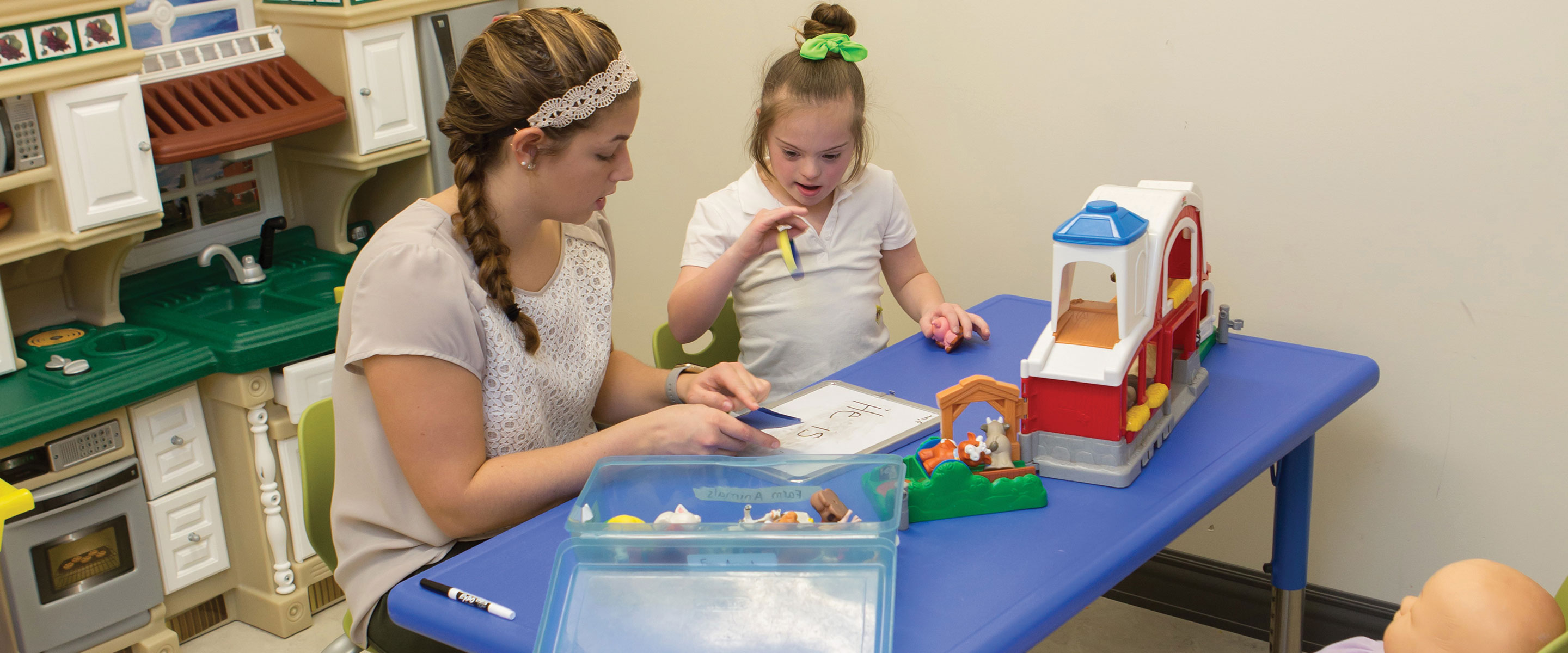
The ESU Speech-Language Pathology program has an on-campus clinic equipped with the technology and materials that better prepare students for externship placements.
The program offers its students an on-campus facility that provides supervised hours and experience before going out into the field. The clinic’s client base is extensive and offers real world experience with individuals who have a variety of disorders. Work with groups and off campus screenings are also included.
Why ESU?
The Speech-Language Pathology on-campus clinic consists of 12 therapy rooms that can be observed in faculty offices (supervision) or in a specially designed observation room for the parents, spouses, and families of clients.
Additionally, a variety of equipment and technologies are available in the lab and audiology suite to help with evaluation and therapy.
I chose ESU for many reasons. First and foremost, ESU has a great reputation for their speech and language pathology program.
Megan Harding B.S. '19 M.S. ’21
Pre-Graduate Certificate Program
East Stroudsburg University Department of Speech, Language, and Hearing Sciences provides a 21-credit prerequisite concentration that may be taken on main campus after approval from the department chair.
The prerequisite courses are designed for students holding a bachelor's degree in another major who need prerequisite courses to apply to a master's program in speech-language pathology or communication sciences and disorders.
Taking these classes does not guarantee acceptance into the ESU Communication Sciences & Disorders Master's Degree program.
- Prerequisite classes can be completed in one academic year
- Non ESU students may register as non ESU students
- Students currently enrolled at ESU may register through the ESU portal
- Any questions should be directed to Dr. Rachel Wolf, rewolf@esu.edu
- To apply as a non-degree student, send email request to Office of Admissions, admission@esu.edu
Undergraduate preparation to include the following prerequisites:
- Speech-Language Pathology or Communication Disorders courses:
- Introduction to Communication Disorders
- Speech and Language Development
- Phonetics
- Introduction to Audiology
- Speech Science
- Anatomic and Physiologic Bases of Speech
- Advanced Speech & Language Disorders (or Equivalent)
- Other undergraduate courses:
- Child development or developmental psychology
- Statistics
- College level math course (other than statistics)
- English composition/writing
- Natural sciences (6 credits), one must be biology, the other may be chemistry or physics
- Behavioral sciences (6 credits)
- Observation hours: Students need 25 observation hours that can be obtained at a variety of facilities, such as: schools, hospitals, nursing homes, rehabilitation hospitals, and private practice. The prospective student must observe ASHA certified SLPs. Students should consult the department chair about the details of this requirement. These hours must be completed prior to beginning any graduate program in speech-language pathology or communication sciences and disorders.
Prospective students who do not have the above undergraduate courses or their equivalents may choose to complete them at any accredited university. It should be noted that not all applicants who meet the above admission requirements will be accepted into the program due to limitations in the number of student seats available at the time of acceptance.
Respected Accreditation
The Master of Science (M.S.) education program in speech-language pathology (residential) at East Stroudsburg University is accredited by the Council on Academic Accreditation in Audiology and Speech-Language Pathology (CAA), of the American Speech-Language-Hearing Association (ASHA), 2200 Research Blvd. #310, Rockville, Maryland 20850, (800) 498-2071 or (301) 296-5700.
The graduate program is also approved by the Pennsylvania Department of Education.
Internships and Research Opportunities
All students in the program complete both a school-based placement and a medically based internship placement. Placements are generally in eastern Pennsylvania or New Jersey, but other locations may be possible with some planning.
Research opportunities include the writing and presentation of a thesis paper. Or students can work with faculty members on faculty-led projects.
Student Organizations
The ESU chapter of the National Student Speech-Language-Hearing Association is a very active group that has received both campus and national awards for their community service activities.
Degree Requirements
Academic Coursework (prerequisite courses may be necessary for those without an undergraduate speech pathology degree)
Clinical Practicum and Externship
Clinical Practicum at ESU Speech and Hearing Center: Students will be enrolled in SPPA 550, Advanced Clinical Practicum, (in the ESU Speech and Hearing Center) for three semesters, typically during their second through fourth semesters includes a summer). Student clinicians work with clinical supervisors to set a schedule for management of clients in the clinic. Clinical education is individualized to the needs of the student clinicians.
Clinical Externship (off campus): All students will complete two full time semester of SPPA 586, Advanced Clinical Externship, at two different off-campus sites, typically in the last semesters of enrollment. A variety of clinical externship sites are available off-campus; these are arranged by the departmental externship coordinator. Students may suggest off campus externship sites at which they would like to work, but all practicum sites must be arranged and administered through the department.
Each student will be required to meet the clinical education requirements for the ASHA CCC-SLP.
The ASHA CCC-SLP clinical education requirements may be met through a combination of undergraduate and clinical practicum work. Students who wish to receive credit for undergraduate clinical practicum must provide the graduate coordinator with adequate documentation of the undergraduate practicum work. Students must complete 25 hours of clinical observations, and 375 hours of clinical management practicum. At least 325 of the minimum 375 clinical practicum hours must be acquired at the graduate level (while a graduate student in the program).
Portfolio
Students are required to prepare a portfolio of learning outcomes for faculty review
during their last semester of enrollment.
Students are accepted into the graduate program as either Full Time or Part Time students.
- The only distinction between the two is that part time students enroll in fewer credits per semester than full time students, usually due to their other commitments.
- Otherwise, the two groups are the same. The admission standards, degree requirements, and all academic policies and regulations are the same.
- Full Time students are expected to complete 4 academic semesters and two summer terms (Fall, Spring, Summer, Fall, Spring).
- Part Time students will generally take longer to complete the degree, but are expected to make regular and consistent progress.
- Part Time students are subject to the ESU Graduate School policy of completion of the degree program within 6 years of initial enrollment.
- Part Time students are expected to enroll for as many credits as feasible, usually 6 credits per semester in the Fall and Spring, and close to a full load in Summers if possible.
- Part Time students may, upon written request to the Graduate Coordinator, take more than 6 credits per semester in the Fall or Spring semesters, subject to availability of seats for courses, and subject to caseloads and site availability for practicum.
The department no longer guarantees that part-timers will be able to complete their degree by attending only evening and summer classes.
Students will be allowed to transfer up to 6 graduate semester hours into their plan of study in the program from other ASHA accredited training programs, as long as the courses correspond to ESU degree requirements, as judged by the ESU program faculty, and have not been used to satisfy degree requirements elsewhere.
The transferred credits must comply with the ESU Graduate School policy on transfer credits.
Teaching Certification
Students may choose to complete requirements for Pennsylvania Instructional I certification as a Teacher of the Speech-Language Impaired as part of their master's degree program.
This certification would allow the student to work in the school settings in Pennsylvania.
The following requirements are necessary to qualify for Pennsylvania Teacher Certification:
- Students must complete all master's degree requirements
- Pass the appropriate Praxis exams
- Submit an application to the Pennsylvania Department of Education (PDE).
The teacher certification option is available only to students already admitted to the M.S. in Speech-Language Pathology program.
Students must enroll in two sections of SPPA 586-- Advanced Clinical Externship over two semesters.
- One of the sections will be a school placement.
- All master's level students, whether seeking teacher certification or not, will complete one externship placement in the school setting.
Required test scores and cumulative grade point average:
- Below a 3.0- candidate does not qualify for teacher certification.
- Students must take two Praxis exams for teacher certification with the appropriate passing scores listed below
- Fundamental Subjects: content Knowledge (5511) Passing scores according to GPA
- Qualifying Score: 3.0 GPA score of 150
- Qualifying Score: 3.1-3.25 GPA score of 149
- Qualifying Score: 3.26-3.5 GPA score of 147
- Qualifying Score: 3.51-3.75 GPA score of 146
- Qualifying Score: 3.76-4.0 GPA score of 145
- Speech-Language Pathology (NESPA Exam) passing score 162 (test #5331)
Students must pay registration fees plus a separate fee for each test!!
The Praxis exams are a requirement of the Pennsylvania Department of Education (PDE).
Speech Language Specialist - Students may also opt to become a speech-language specialist in lieu of teacher certification.
Student Outcome Data
The Master of Science education program in Communication Sciences & Disorders at East Stroudsburg University is accredited by the Council on Academic Accreditation in Audiology and Speech-Language Pathology of the American Speech-Language-Hearing Association, 2200 Research Boulevard #310, Rockville, Maryland 20850, (800) 498-2071 or (301) 296-5700.
Student Completion Rates
| Period | # Completed in Expected Time Frame |
% Completed in Expected Time Frame |
|---|---|---|
|
2026
|
15/15
|
100%
|
|
2025
|
18/18
|
100%
|
|
2024
|
23/23
|
100%
|
|
**Student completion maybe delayed for a variety of reasons including personal, financial,
health, etc.
|
||
Praxis Examination Pass Rates of Test-Takers
| Period | # Taking Exam | # Passing Exam | % Passed Exam Rate |
|---|---|---|---|
|
2026
|
14
|
14
|
100%
|
|
2025
|
13
|
13
|
100%
|
|
2024
|
23
|
23
|
100%
|
Strategic Theme 1: Academic Excellence and Regulatory Alignment
Goal: Deliver a rigorous curriculum that meets all CAA accreditation criteria and seamlessly merges fundamental clinical knowledge with emerging modern competencies.
-
Objective A: Map and cross reference all syllabi and formative/summative rubrics against the official CAA Accreditation Standards to guarantee flawless mastery across the Big 9 clinical domains.
-
Objective B: Systematically integrate comprehensive clinical counseling modules across the curriculum to prepare students for the complex affective dimensions of hearing, communication, and swallowing disorders.
-
Objective C: Modernize courses to include the functional use, data privacy implications, and ethical boundaries of Artificial Intelligence (AI) in clinical diagnostic and therapeutic administrative workflows.
Strategic Theme 2: Clinical Innovation and Technological Integration
Goal: Graduate technologically fluent clinicians who use advanced toolsets while prioritizing human-centric, empathetic care and equipping graduates with the specific skills and competencies highly sought after by today's employers.
-
Objective A: Embed AI-assisted diagnostic software, speech analysis tools, and automated clinical documentation simulators safely into on-campus clinic operations.
-
Objective B: Faculty Development & Empowerment: Support faculty growth and reward teaching innovations that elevate classroom excellence and meet external benchmarking standards.
-
Objective C: Implement at least two AI-driven evidence-based educational platforms (such as automated language transcription tools or AI-scaffolded diagnostic simulation software) within the clinical methods course sequences.
Strategic Theme 3: Artificial Intelligence Literacy
Goal: Graduate students who are literate in the pros/cons and uses of AI technology in the field of speech pathology legally and ethically.
- Objective A: Ensure 100% of students demonstrate entry-level proficiency in evaluating the accuracy, algorithmic bias, and HIPAA compliance of commercial AI clinical tools, verified through a summative assessment.
- Objective B: Provide training that reduces average student documentation time using ethical, HIPAA-compliant generative AI draft workflows and documentation software monitored during on-campus clinical practicum.
- Objective C: Across the curriculum provide knowledge and skills to ensure ethical and appropriate use of AI including ensuring ethical responsibility, prioritizing patient and clinical security, obtaining informed consent and citing generative AI.
- Objective D: Prepare students to use AI to ethically and legally transform and strengthen learning, clinical reasoning, efficiency and professional competence.
Strategic Theme 4: Advanced Clinical Counseling Competency
Goal: Provide students with the knowledge and skills to provide effective counseling regarding communication disorders.
- Objective A: Develop standardized patient simulation labs focused specifically on high-stakes clinical counseling scenarios. These include discussing a terminal diagnosis, delivering a new dysphagia diagnosis, treatment recommendations and managing client/caregiver resistance.
- Objective B: Integrate specialized counseling training (such as use of ICE, Cognitive Behavioral Therapy techniques for stuttering or grief counseling models for degenerative developmental and neurological conditions, dysphagia and treatment adherence) into at least three core academic courses spanning audiological, communication, and swallowing disorder content.
- Objective C: Explore feasibility of a formative "Counseling OSCE" (Objective Structured Clinical Examination) in partnership with ESU's Nursing program, adapting their existing standardized-patient simulation infrastructure for speech-language pathology counseling scenarios spanning both communication and swallowing disorders.
- Objective D: Achieve a score of "Proficient" or higher for 100% of students on the communication and counseling items of the final Clinical Assessment of Learning, Engagement, and Performance (CALIPSO) evaluation completed by externship supervisors.
- Objective E: Prepare graduate students to use trauma‑Informed practice including watching for signs of stress, including withdrawal, difficulty concentrating, irritability, or sudden absences, respond with patience and empathy when fear influences behavior and referring clients promptly to counselors, social workers, or other support staff.
Admission Requirements and Deadlines
The application for the ESU Communication Sciences & Disorders graduate program opens in CSDCAS at the start of the Fall semester 1 year prior to anticipated start date. After creating your profile and beginning the general CSDCAS application, you will have the option to select East Stroudsburg University as one of the institutions to which you are applying. CSDCAS is the centralized application system used by most CSD/Speech-Language Pathology programs across the country.
All application documents, transcripts, and supporting material must be received no later than February 1st for fall admission. Admission decisions are generally made in March.
Graduate assistantships are available through the Department of Communication Sciences & Disorders for first-year students. These are awarded based upon merit and achievement to full-time students in the graduate program.
There are graduate assistantships available in other academic departments as well.
Graduate assistants do not teach classes, but complete projects and tasks assigned by professors.
Prospective students should apply for a graduate assistantship at the time of original application to the program, using the on-line application.
Students must be admitted to both the ESU Graduate College and the M.S. in Communication Sciences & Disorders program
Questions may be directed to, Dr. LuAnn Magnuson, the department graduate coordinator, at lmagnuson@esu.edu
- Proof of a completed bachelor’s degree
- You must have at least a 3.0 in your major course of study
- You must have at least a 3.0 overall
- Official transcripts of all college work
- Graduate College application (on graduate college page)
- Application fee
- Three letters of recommendation (form may be found on graduate college page)
- Statement of professional goals in essay format (1-2 pages)
** Requirement of GRE results has been waived for 2023 cohort applicants
Speech-Language Pathology or communication sciences and disorders courses that are required include the following
- Introduction to Communication Disorders
- Speech and Language Development
- Phonetics
- Anatomy & Physiology of the Speech and Hearing Mechanism
- Introduction to Audiology
- Speech Science
- Advanced Speech & Language Disorders (or equivalent course that addresses phonological and language disorders
Other Undergraduate courses
- Child Development or Developmental Psychology
- Statistics
- Natural sciences (6 credits), must include 3 credits in biological science, the study of living organisms, and 3 credits in chemistry or physics
- Behavioral sciences (6 credits)
Prospective students who do not have the above undergraduate courses or their equivalents may choose to complete them at any accredited university.
It should be noted that, due to limitations in the number of students who can be accepted into the M.S. Communication Sciences and Disorders program, not all applicants who meet the above admission requirements can necessarily be accepted.
Become a Warrior

Take next step towards earning your Master's degree in Speech Language Pathology at ESU


Contact Us
Campus Address
Monroe Hall 230
(570) 422-3247
Department Chair, Speech, Language, and Hearing Sciences
Dr. Rachel Wolf
rewolf@esu.edu
(570) 422-3929
Graduate Coordinator
LuAnn Batson-Magnuson
lmagnuson@esu.edu
(570) 422-3311