The Biology (B.S.) program at East Stroudsburg University provides students with hands-on, personalized instruction in the fundamental biological principles and techniques for graduates to be successful in the careers and graduate programs of their choice.
The B.S. Biology program at ESU teaches students the fundamental biological principles and techniques for graduates to be successful in the career or graduate program of their choice. Biology faculty have a diverse background of skills and interests, and they mentor students on independent research projects in microbiology, animal and plant biology, pathology, and neuroscience. Our facilities include a microscopy lab including a scanning electron microscope, a research collection of thousands of preserved local animal and plant specimens, a greenhouse, an advanced molecular biotechnology laboratory, and a state-of-the-art marine aquaculture facility.
Our professional affiliations include the Jane Huffman Wildlife Genetics Institute (a leading Lyme Disease testing center in Pennsylvania), the Delaware Water Gap National Recreation Area, and USDA-APHIS.
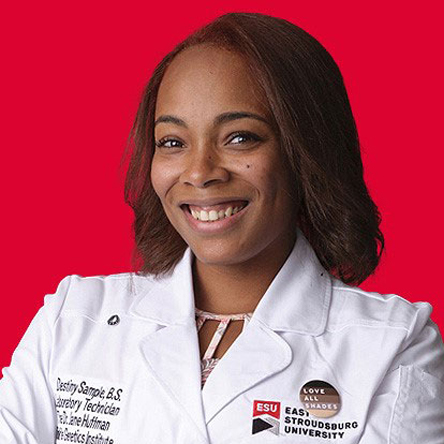
Destiny graduated from ESU in 2019 with her Bachelors of Science in Biology and has since been a laboratory technician at the PA Tick Research Laboratory. She has two years of research experience performing tick testing.
Destiny Sample '19
Biology Major
Why ESU?
Biology faculty have diverse skills and interests, teach a wide range of courses, and mentor students on independent research projects in microbiology, animal and plant biology, pathology, and neuroscience.
Our curriculum gives students the flexibility to design a course plan based on their
interests, while also completing a standard core of
courses in introductory biology, ecology, genetics, and physiology.
Our facilities include a microscopy lab with a scanning electron microscope, a research collection of thousands of local animal and plant specimens, a greenhouse, an advanced molecular biotechnology laboratory, and a state-of-the-art marine aquaculture facility.
What You'll Learn
ESU Biology majors will learn fundamental principles of biology at both cellular and organismal levels. Students will learn standard laboratory techniques including microscopy, spectrophotometry, and polymerase chain reaction, and also standard field techniques used for studying local plants, animals, and ecosystems. Students will also learn about the hierarchy in the diversity of life and the characteristics of major lineages of plants, animals, and other organisms.
Students will learn the following fundamental and critical skills:
- the ability to reason and think critically
- sterile lab technique
- laboratory safety
- field study techniques
- the proficient use of laboratory equipment including microscopes
- the application of the scientific method
- the ability to synthesize, analyze, interpret, summarize and present scientific data
- recognize and relate the different levels of structure in biology from atoms through the biosphere
- correlate structure with function at multiple levels
- recognize the hierarchy in the diversity of life and identify the characteristics of major lineages of organisms
- understand evolutionary theory
- explain how genetic information is copied and transmitted
- and understand ecological relationships among organisms
Concentrations
Biology majors are not required to declare a concentration. However, a student who wishes to focus their studies in one area may choose from among the following concentrations. Alternatively, students may use their elective courses within the general Biology major to further their knowledge in a specific area.
The Integrative Organismal Biology concentration emphasizes the study of the ecology, behavior, and evolution of organisms. The concentration is appropriate for students interested in working in fields such as wildlife management, forestry, environmental consulting, natural history interpretation, environmental education, conservation, museum collection management, zoo/aquarium collections management, and for students planning to attend graduate school in botany, zoology, ecology, behavior, or evolution.
The concentration in Laboratory Medicine prepares students to practice science in this diverse field. The goal of the program is to develop highly literate, compassionate, analytically competent persons who possess extensive contemporary knowledge of medical laboratory skills. Students are urged to participate in scholarly activities such as research, scientific writing, presentation of papers, and attendance at scientific meetings.
The concentration in Pre-Medicine is designed to prepare students for further training as medical professionals in the fields of dentistry, medicine, optometry, podiatry, and veterinary medicine. Required courses for the concentration are tailored to meet the entrance requirements of the desired graduate programs.
Students in the Pre-Physical Therapy concentration are biology majors, but direct their class work and activities toward gaining entrance into schools which offer post-baccalaureate programs leading to a physical therapy license. Entrance into physical therapy schools is highly competitive, and the concentration provides students with a structured curriculum and the rigorous background they need to gain entrance to physical therapy graduate schools. ESU has an established internship program with several physical therapy clinics, providing students with at least 300 hours of experience working alongside a practicing physical therapist.
The Pre-Physician Assistant concentration prepares students to be competitive applicants to post-baccalaureate programs leading to licensing as a physician assistant. Students complete a Biology major with a concentration in Pre-PA studies, which includes specific curricular requirements tailored to provide the background necessary for admission into Physician Assistant graduate programs. Students are also expected to obtain hundreds of hours of clinical experience outside the classroom, and there are many opportunities available at local medical facilities.
ESU's Secondary Education concentration provides the scientific and educational background needed for Secondary Education certification in Biology. The requirements for certification include successful completion of coursework in Biology, Chemistry, Physics, and Math; completion of courses in the College of Education, and a culminating semester-long student teaching experience.
The General Biology concentration provides a strong overall foundation in the biological sciences to prepare students for a wide range of careers and graduate programs.
Student Organizations & Honor Society
Each club provides students the opportunity to network with their peers, develop friendships, and participate in club activities such as fundraisers, charity events, field trips, and hosting professional seminars.
The Biology Club is here for students that care about biology and the environment. Students are introduced to the world of biology by going on trips with opportunities to visit different ecosystems to help build community among life science students. Also, we aim to show students about careers available biology majors. Faculty advisor: Dr. Whitford, (570) 422-3713.
This club strives to expand knowledge on current techniques and inform the community of currently available abilities that the biomedical and biotechnology fields have to offer. Faculty advisor: Dr. Aldras, (570) 422-3704.
We promote the conservation of natural resources to benefit the health and safety of the environment around us. We have many opportunities to work with not only club members and other clubs on campus, but also a variety of organizations to help make campus more sustainable, as well as our community. We have regularly scheduled campus and Adopt a Block cleanups, and also promote recycling through a variety of projects. There are also annually-scheduled fun trips and events as well, like Zumba for a Cure, Hershey Park, hiking trips, and the Philadelphia Zoo. Faculty advisor: Dr. Wilson, (570) 422-3212.
The purpose of the Marine Science Club is to increase understanding and involvement in all facets of the marine sciences through guest speakers, and trips to aquariums and marine stations. Faculty advisor: Dr. Hunt, (570) 422-3715.
The Pre-PA Club is a group designed to assist Pre-Physician Assistant students in becoming competitive applicants by providing opportunities to learn more about the profession, shadowing, and patient care opportunities, as well as connect with other ESU students. Faculty advisor: Dr. White, (570) 422-3712.
This organization supports and guides incoming all pre-medical students, including pre-veterinary, pre-osteopathic, pre-podiatric, pre-dental, pre-optometric, and pre-chiropractic students, and introduces students to the professional medical fields. Faculty advisor: Dr. Loomis, (570) 422-2708.
Outstanding senior students in biology are nominated for annual awards in the >Sigma Xi Scientific Society, a professional scientific research organization affiliated with all ESU Science Departments.
Career Opportunities
Graduates of ESU’s Biology program go on to graduate programs and obtain jobs and build successful careers in a variety of disciplines and industries. Our graduates have been accepted into a wide range of graduate schools including biomedical programs, education programs, dental and medical schools, veterinary schools, physical therapy schools, physician assistant schools, and research programs in biological sciences.
Our alumni earn positions in:
- Biology Technician and Teacher
- Conservation Officer
- Entomologist
- Environmental Educator
- Game Commission Officer
- Histology Technician
- Hospital Lab Scientist
- Laboratory Technician
- Naturalist
- Ornithologist
- Park Ranger
- Research Technician
- Wildlife Biologist
- Zoologist
Internships and Research Opportunities
The Biology program partners with numerous organizations to offer student internships in a variety of fields. The most common organizations that provide internships are hospitals, clinics, and private medical offices; environmental organizations and consulting firms; pharmaceutical companies; and local, state, and federal scientific agencies. With these opportunities, students work closely with lab scientists and field biologists learning specialized techniques and gaining invaluable hands-on experience.
Additionally, many professors in the Biology program mentor student research projects in their disciplines. Students gain invaluable hands-on experience by gathering, analyzing, summarizing, and presenting scientific data and results. Some examples of recent student research projects:
- Entomology: spotted Lanternfly field research
- Mammalogy: monitoring local bat populations
- Neurobiology: decoding complex mixtures of visual signals in the brain
- Botany: plant/insect interactions with aphids and milkweed
- Herpetology: monitoring of timber rattlesnake populations in Pennsylvania
- Environmental Studies: monitoring of freshwater invertebrates
- Marine Biology: substrate preference of the summer flounder in New Jersey
- Microbiology: prevalence of Powassan virus and Lyme disease in local ticks; a novel aquatic microbacterium species that produces antibiotics; environmental changes that impact growth of a pathogenic fungal species.
- Anatomy & Physiology: examining the tissues of stomachs in small mammals
Career Development at ESU
We'll help you launch your career. Support services are available through the ESU Career Development Center. The center offers a variety of internship opportunities, career planning, and employment services to all ESU students and alumni.

Become a Warrior

Become a leader in Biology at ESU
Contact Us
Campus Address
Moore Biology Hall 208
(570) 422-3725
Co-Department Chair, Biological Sciences
Dr. Emily Rollinson
Moore Biology Hall 103
erollinson@esu.edu
(570) 422-3971
Co-Department Chair, Biological Sciences
Dr. Matthew Wallace
Moore Biology Hall 208
mwallace@esu.edu
(570) 422-3720