
Our experienced faculty better prepare ESU Criminal Justice program graduates.
In addition to having extensive academic and research backgrounds, each of our full-time and part-time Criminal Justice faculty members have spent some of their careers working in the field. Ranging from law enforcement, juvenile justice, corrections, correctional counseling and rehabilitation, our faculty is able to provide an added level of mentorship and guidance to our students leading up to their graduation.
Additionally, a key feature of the ESU Criminal Justice program is our internship requirement. While other programs may allow students to pursue elective in-field internships, ESU requires internship participation for all students. These valuable internship placements provide opportunities to integrate theory into practice. Students complete the CJ program at ESU with relevant experiences that they can then highlight on their resumes as they prepare to enter their chosen career field.
Why ESU?
The ESU Criminal Justice program is interdisciplinary by design. Criminal Justice is placed within the Department of Sociology, Social Work, & Criminal Justice. Our faculty teaches across all three programs, providing and broad array of knowledge and experiences.
This significant cross-pollination between each discipline enables students to further their preparation academically and professionally for real world employment.
What You'll Learn
- Students will learn the key aspects of the criminal justice system, in particular its primary subcomponents: law enforcement, courts, corrections, and juvenile justice.
- In addition, the program offers an array of electives geared towards those interested in higher level critical criminological theory.
- Students will also be prepared to enter an array of Criminal Justice careers, as well as many of the related and/or overlapping human service systems affecting or affected by the criminal justice system.
- Students progress through our program, moving from learning the basic structure and function of these systems, to rigorous critical thinking and analysis of how these systems function in a diverse and dynamic society that is ever-changing.
- Students can also expand their preparation for their careers by minoring or double-majoring in Sociology or Social Work within our multidisciplinary department, or by completing the Crisis Intervention Certificate offered jointly by Social Work and Psychology.
- Students gain the knowledge, and preparation for employment opportunities in a range of criminal justice settings.
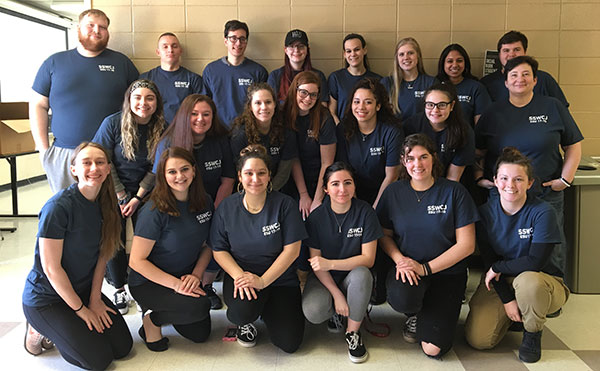
The Sociology, Social Work & Criminal Justice Club:
hosts Community Issues Forums/Speakers
co-sponsors the annual “Night Without a Home” and “First Responder” events on campus
coordinates field trips to various community-based organizations
develops and implements community service projects
Additionally, each major program in the department has an honor society that recognizes student academic excellence. For criminal justice, there is a department chapter for the Alpha Phi Sigma National Honor Society for Criminal Justice.
Career Opportunities
Hand-on Opportunities
Internships
All Criminal Justice students are required to complete an internship during their senior year that can range from 120-600 hours in the field. These internships occur in a variety of criminal justice system settings including:
Career Development at ESU
We'll help you launch your career. Support services are available through the ESU Career Development Center. The center offers a variety of internship opportunities, career planning, and employment services to all ESU students and alumni.

Become a Warrior