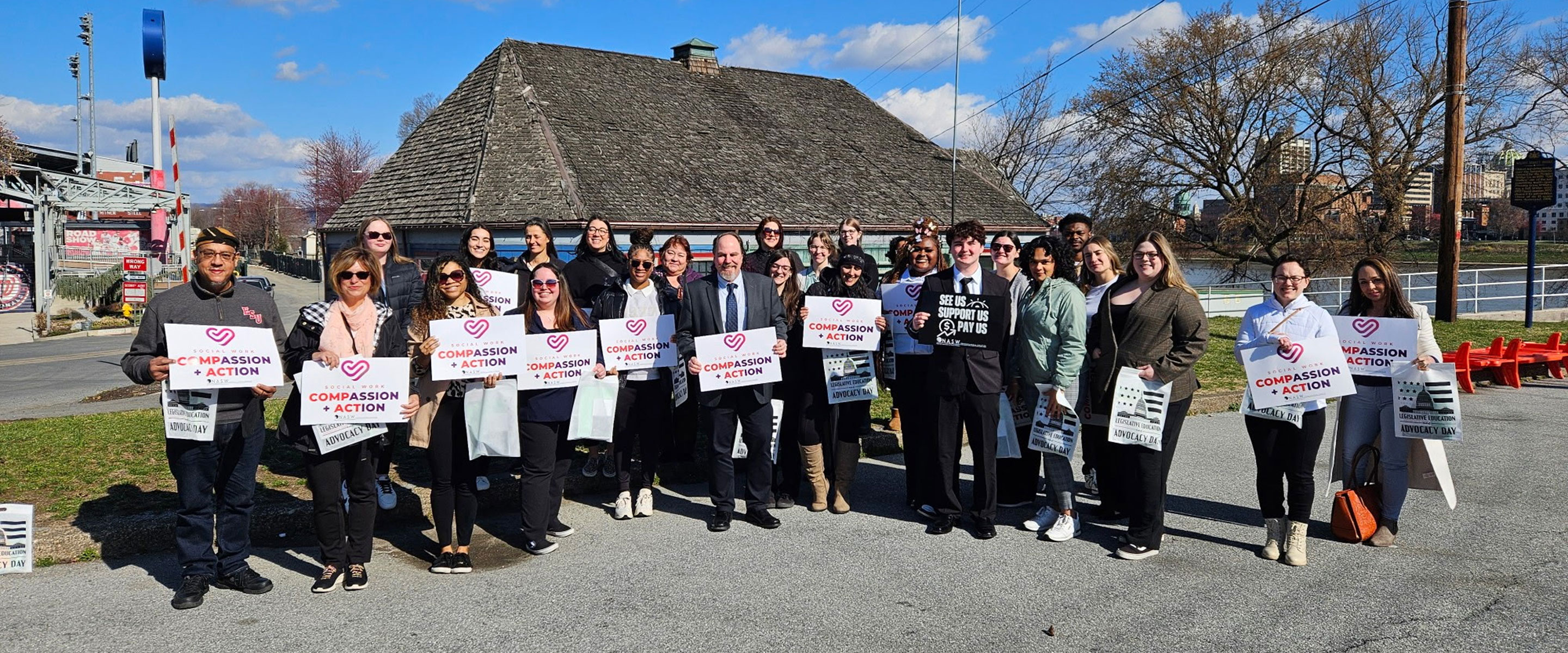
The ESU BSSW Program prepares students for generalist practice in an array of social service settings including those in behavioral health, medical social work, child welfare, community organizing, homeless assistance, school social work, and others.
Program Mission
The mission of the Bachelor of Science in Social Work (BSSW) Program at East Stroudsburg
University of Pennsylvania is to create an inclusive educational environment that
prepares students to engage in professional practice that works to dismantle racism
and systems of oppression. Our purpose is to educate to advance human rights, and
social, racial, economic, and environmental justice and to prepare competent generalist
practitioners who can respond to the needs of an increasingly diverse and rapidly
changing society. In the diverse campus and exurban communities in which we are situated,
we respect the dignity and worth of all people and commit to the values of integrity,
the importance of human relationships, social justice, competence, and service with
an enhanced emphasis on meeting the needs of those from underrepresented populations.
The BSSW Program embraces global and person-in-environment perspectives in efforts
to enhance the quality of life of all people, engages in scientific inquiry to expand
knowledge, and commits to practices that seek the elimination of poverty. The program
also provides knowledge of culturally responsive, evidence-informed, integrative approaches
that can be utilized with the diverse clients that students will serve. The program
also emphasizes that self-care is paramount for competent and ethical social work
practice. It is our calling to provide students with the educational background necessary
as competent generalist social work practitioners to embrace the strengths embedded
in our community while assisting in addressing the shifting needs within it; and to
ensure that BSSW graduates have the essential preparation to successfully pursue graduate
study in social work.
Why ESU?
The Council on Social Work Education (CSWE) Accredited ESU Social Work Program is situated in a multidisciplinary department affording opportunities for students to minor or double-major in sociology or criminal justice enabling expanded preparation for real world employment within interdisciplinary professional practice settings.
Additionally, full-time and part-time ESU Social Work faculty members have spent years as practitioners in the field before becoming social work educators.
These practice settings include mental health, child welfare, substance abuse treatment, medical social work in hospitals and hospice agencies, forensic social work, family services and an array of other settings.
These experiences inform what takes place in the classroom and further enables students to emphasize the integration of theory into practice across numerous experiential learning opportunities including the 400-hour field experience during the senior year.
What You'll Learn
- Students are educated in generalist social work practice, and will gain the knowledge, skills, and beginning competence necessary to intervene with individuals, families, groups, organizations, and communities in many different social work practice settings addressing a variety of social problems experienced in society.
- Students learn various practice methods to provide services to a wide-range of client populations within a Person-in-Environment framework.
- Every social work student will complete experiential learning in the form of a 400-hour field experience during their senior year. This is an excellent opportunity for students to apply theory into practice in a highly supervised experience. The department has nearly 200 affiliation agreements with settings located across a wide geographic area where students can complete their internship. These field placement agencies include practice settings in mental health, substance abuse treatment, child welfare, medical social work, school social work, homeless assistance, domestic violence prevention, and numerous others.
- Every student takes a course in quantitative analysis and one in research methods. From these courses students learn how to design research projects, analyze and interpret data. These critical skills are needed in today’s job market as students will engage in evaluation research in the practice settings where they are employed.
- Our students have excellent success in obtaining employment after graduation. Additionally, many of our social work students choose to pursue advanced graduate study in social work.
- Students interested in child welfare also have the opportunity to apply for the Child Welfare Education for Baccalaureates (CWEB) program, which is a cooperative effort among the US Administration for Children and Families and the PA Department of Human Services, and for which ESU’s social work program is an affiliate.
- The program offers an array of electives including Child Welfare Services, Drug Use and Abuse in Society, Crisis Intervention, Juvenile Delinquency, among others, to further student learning in these areas of interest.
- We also encourage our students to expand their preparation for careers by minoring or double-majoring in Sociology or Criminal Justice in our department, or in related programs like the Crisis Intervention Certificate offered jointly by Social Work and Psychology.
Evaluation of Conduct Record
Please be advised that programs leading to state licensure or certification may require evaluation of conduct records, such as but not limited to criminal background checks, as a condition of licensure.
Specific questions regarding this matter should be directed to one’s advisor, department chair, or college dean.
Learning Opportunities
All CSWE accredited programs measure and report student learning outcomes (see AS B5.0.1(d)).
9 Competencies
- Competency 1: Demonstrate Ethical and Professional Behavior
- Competency 2: Advance Human Rights and Social, Racial, Economic, and Environmental Justice
- Competency 3: Engage Anti-Racism, Diversity, Equity, and Inclusion (ADEI) in Practice
- Competency 4: Engage in Practice-Informed Research and Research-Informed Practice
- Competency 5: Engage in Policy Practice
- Competency 6: Engage with Individuals, Families, Groups, Organizations, and Communities
- Competency 7: Assess Individuals, Families, Groups, Organizations, and Communities.
- Competency 8: Intervene with Individuals, Families, Groups, Organizations, and Communities
- Competency 9: Evaluate Practice with Individuals, Families, Groups, Organizations, and Communities
Council on Social Work Education (CSWE) Competencies (Educational Policy & Accreditation Standards, 2022)
Accreditations / Recognition
The ESU Social Work Program received Initial Accreditation from the Council on Social Work Education (CSWE) in 2015, and Reaffirmation of Accreditation in 2019 for 8 years.
Graduating with an accredited undergraduate degree in social work, like the one offered at ESU, provides eligibility for program graduates to apply for "advanced standing" into accredited MSW Programs across the US.
Student Organizations
ESU's chapter of Chi Phi Chapter of the Phi Alpha Honor Society for social work majors
The Sociology, Social Work & Criminal Justice Club is open to all majors and minors in the department and provides an interdisciplinary opportunity for club members to plan Community Issues Forums/Speakers, and co-sponsor the annual “Night Without a Home” and “First Responder” events on campus.
The Club also coordinates field trips to various community-based organizations; and develops and implements community service projects.
Career Opportunties
Our alumni earn positions in:
- Substance Abuse Treatment Programs
-
Mental Health Programs
-
Child Welfare Agencies
-
Domestic Violence Agencies
-
Healthcare Settings (e.g. hospitals, hospice)
-
Agencies on Aging
- Residential Treatment Programs
- Homeless Assistance Programs
- Anti-Poverty Programs
- Probation Departments/Juvenile Justice Programs
- Community Action Agencies
Hands-on Learning
Research Opportunities
Students across each major in the department have had the opportunity to serve as research assistants on a variety of faculty-led research projects related to different facets of the fields of sociology, social work and criminal justice.
Social work students have recently engaged in faculty-led research focused on the recovery model in mental health.
Additionally, students can engage in faculty-supervised independent studies for academic credit that examine and analyze contemporary issues and practice trends in social work.
Internships
Social work students are required to complete field experiences. Students will complete a 400-hour internship in a variety of social work practice settings including:
- Substance Abuse Treatment Programs
- Mental Health Programs
- Child Welfare Agencies
- Domestic Violence Agencies
- Healthcare Settings (e.g. hospitals, hospice)
- Agencies on Aging
- Residential Treatment Programs
- Homeless Assistance Programs
- Anti-Poverty Programs
- Probation Departments/Juvenile Justice Programs
- Community Action Agencies
Career Development at ESU
We'll help you launch your career. Support services are available through the ESU Career Development Center. The center offers a variety of internship opportunities, career planning, and employment services to all ESU students and alumni.
Become a Warrior

Take the next step toward earning a degree in Social Work at ESU



Contact Us
Campus Address
Stroud Hall 101
(570) 422-3453
Department Chair, Sociology, Social Work & Criminal Justice
Dr. Carrie Maloney
cmaloney5@esu.edu
(570) 422-3448